Titanium Clad Copper Composite Busbar: Multiple Cross Sectional Shapes for Different Industrial Applications
In highly corrosive environments such as electrolysis, electroplating,hydro metallurgy, and the chlor-alkali industry, the choice of conductive material directly impacts equipment service life and production efficiency. Titanium clad copper composite has become the standard solution in these fields because it combines titanium's corrosion resistance with copper's high conductivity.
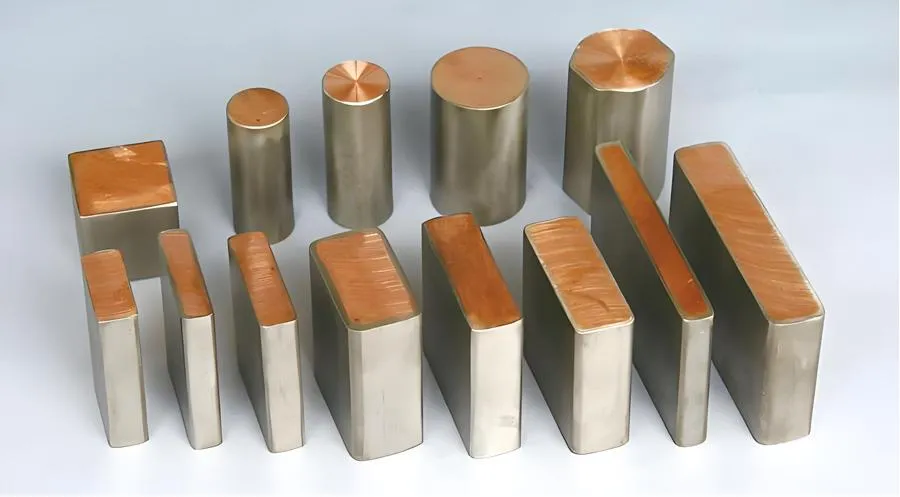
However, different application scenarios require different cross-sectional shapes for conductive materials. This article systematically reviews six cross-sectional shapes available for titanium clad copper and their typical applications, providing a reference for industry users.
1. Six Cross-Sectional Shapes and Specification Ranges
According to industry standards, titanium clad copper composite is available in six main cross-sectional shapes:
|
Shape
|
Specification Range (mm)
|
Typical Applications
|
|
Round
|
Φ 8 ~ 80
|
General-purpose conductive bars, anode substrates
|
|
Square
|
Side length 6 ~ 50
|
Precise positioning and installation
|
|
Rectangular/Flat
|
Width 20~150 Thickness 6~30
|
Highcurrent busbars
|
|
Drum-shaped
|
Φ25~34 ×14
|
Specialized for metal anode electrolyzers
|
|
Wire
|
Φ2.0 ~ 8.0
|
Small components, bending applications
|
|
Combined/Welded
|
Custom-made
|
Shaped electrodes, complex structures
|
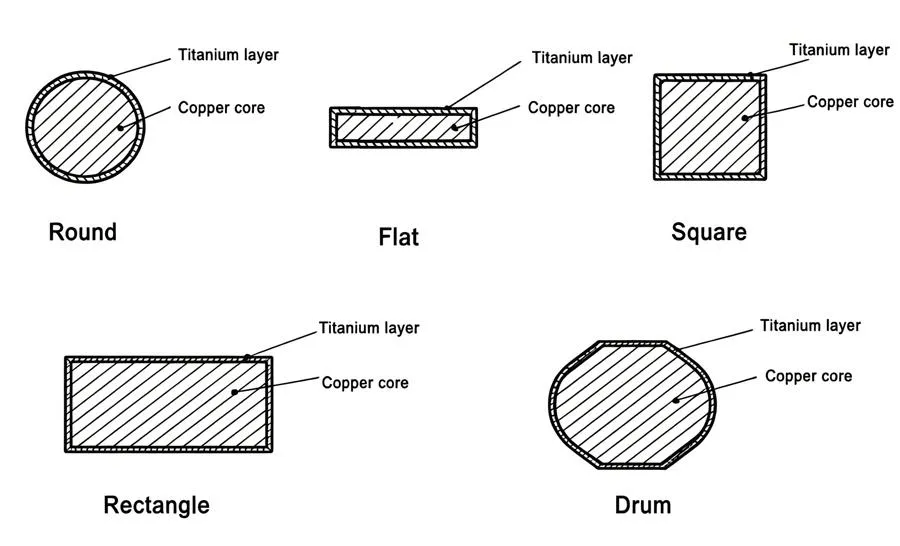
2. Technical Characteristics and Applications by Shape
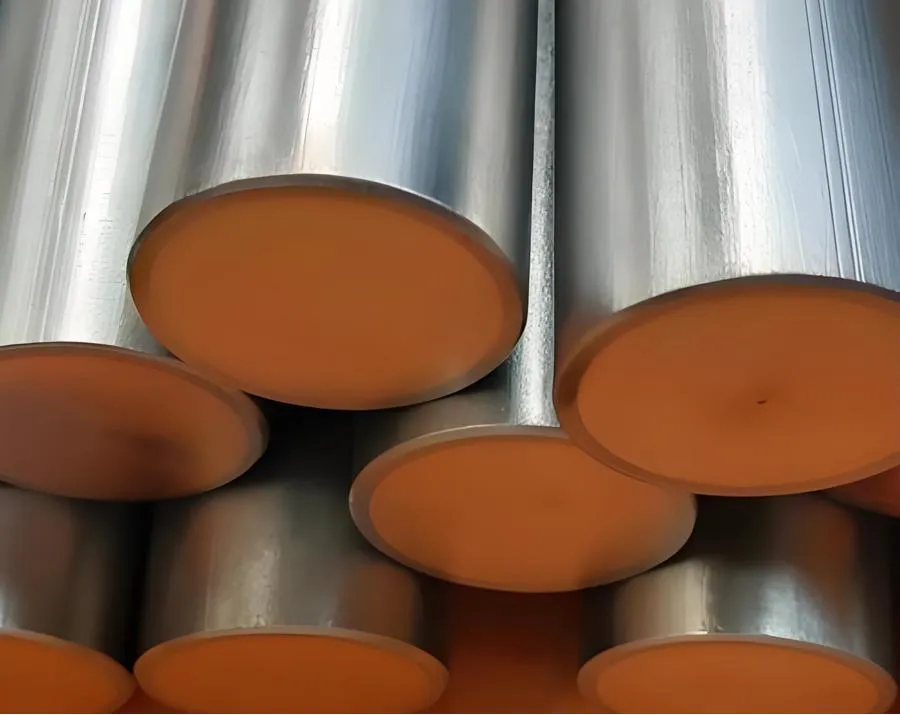
2.1 Round Bar: Most Versatile
Round cross-section is the most mature shape for titanium clad copper, suitable for electrolyzer conductive bars, MMO (Mixed Metal Oxide) anode substrates, and ICCP (Impressed Current Cathodic Protection) system components.
Technical advantages:
Uniform current distribution, no risk of corona discharge
Easy to process—bending, turning, and welding are straightforward
Simple end sealing and reliable connection
Typical application: Conductive beams for suspending anode plates in hydrometallurgical electrolyzers.
2.2 Square Bar: Easy Positioning and Installation
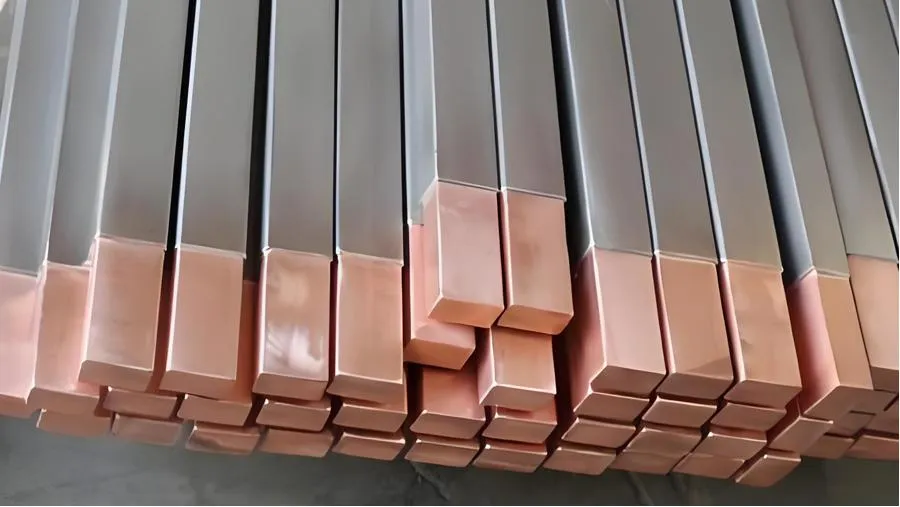
Square cross-section has four flat sides, making it suitable for conductive components requiring precise fixation and positioning.
Technical advantages:
Easy to position in equipment, does not roll
Larger contact surface with fixtures and brackets for stable connection
Typical application: Conductive clamping components in PCB electroplating equipment and automated electroplating production lines.
2.3 Rectangular/Flat Bar: Preferred for High Current Busbars
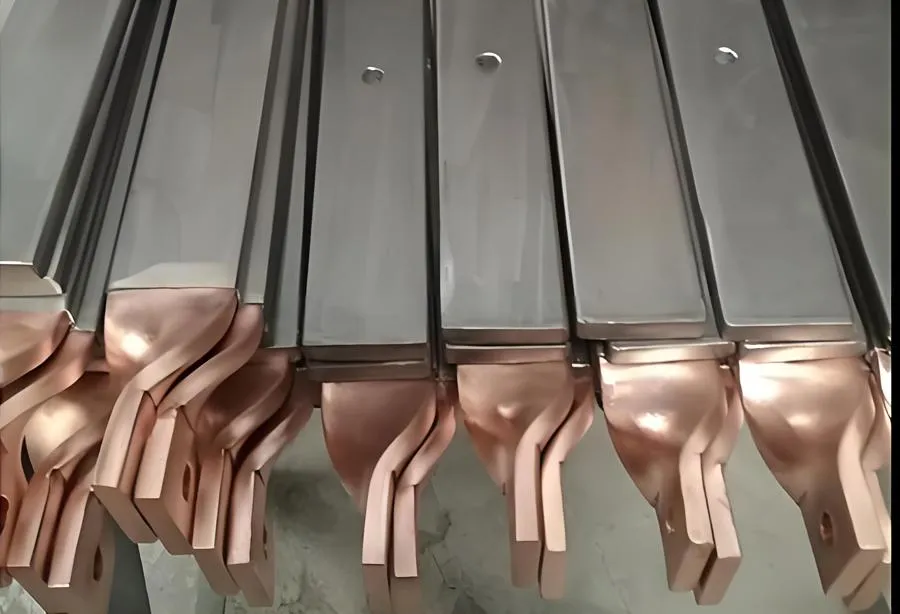
Rectangular (or flat) shape is the standard form for titanium clad copper busbars and the preferred choice for high-current transmission applications.
Technical advantages:
For the same cross-sectional area, flat shape provides larger surface area for better heat dissipation
Higher current-carrying capacity
Easy to stack or arrange closely for efficient space utilization
Manufacturing requirement: When width-to-thickness ratio≥6, specialized processes are required to ensure cladding quality.
Typical application: Main conductive busbars in chlor-alkali electrolyzers—for example, the 25.4×12.7 mm specification at 2900 mm length is a mature product solution in the industry.
2.4 Drum Shape: Specialized for Electrolyzers
Drum-shaped cross-section is designed for specific electrolysis equipment. Common specifications includeΦ25×14, Φ27×14, Φ29×14, Φ32×14, and Φ34×14 mm.
Technical advantages:
Optimized current distribution due to specialized cross-sectional profile
Rounded corners reduce stress concentration
High compatibility with specific electrode fixtures
Typical application: Specialized conductive bars for metal anode electrolyzers.
2.5 Wire: Small Diameter for Fine Components
Wire products can be as small asΦ2.0 mm, suitable for conductive components requiring bending or weaving.
Technical advantages:
Good formability, easy to bend into shape
Can be used to fabricate anode baskets, conductive mesh, and similar structures
Typical application: Small-diameter anodes or conductive wires, as well as components welded together with other shapes.
2.6 Combined/Welded Shape: For Custom Designs
Different cross-sectional shapes can be welded together to meet complex equipment installation requirements.
Technical advantages:
Maximum design flexibility
Different cross-sectional profiles can be achieved within a single conductive component
Typical application: Shaped electrodes, non-standard equipment conductive components.
3. Shape Selection by Industry
|
Industry
|
Common Shapes
|
Selection Rationale
|
|
Chlor-Alkali Industry
|
Rectangular, Drum-shaped
|
High-current busbar + specialized anode structure
|
|
Hydrometallurgy (Cu/Zn/Ni electrowinning)
|
Round, Rectangular
|
Versatility + high-current capacity
|
|
Electroplating Industry
|
Round, Square
|
Easy installation, good adaptability
|
|
PCB Electroplating
|
Square, Wire
|
Precise positioning requirements
|
|
Cathodic Protection (ICCP)
|
Round
|
Standard anode substrate
|
|
Seawater Electrolysis for Chlorine Production
|
Rectangular, Drum-shaped
|
Seawater corrosion resistance + specialized structure
|
|
Water Treatment / Electrodialysis
|
Round, Rectangular
|
Standard shapes, mature supply
|
4. Selection Recommendations
When choosing the appropriate cross-sectional shape, users can follow these principles:
Prefer standard shapes when possible: Round and rectangular shapes have mature supply chains and stable pricing. Choose these unless special requirements exist.
Determine dimensions based on current requirements:
Low current: Round (Φ20 or smaller) or small square
Medium current: Round (Φ20-50) or rectangular (width≤50 mm)
High-current busbars: Rectangular (width≥50 mm)
Choose shape based on installation method:
Positioning required / anti-roll needed: Square or rectangular
Flexible installation with multi-angle connection: Round
Non-standard shapes can be customized:can support custom cross-sectional shapes based on engineering drawings.
 +86-731-82224155
 8613272400394
 enquiry@jetvisiontitanium.com