Titanium clad copper (Ti-Cu) combines the excellent corrosion resistance of titanium with the high electrical conductivity of copper. It is widely used for conductive components in demanding chemical and electrochemical environments.
For engineers and procurement teams, selecting the right Ti-Cu product involves more than dimensions. Material grades, titanium cladding thickness, bonding quality, tolerances, fabrication and testing requirements should all be considered.
How to Select Titanium Clad Copper
Selection should start with the actual service requirements, including:
Operating environment and corrosion conditions
Electrical conductivity and current requirements
Titanium and copper grades
Titanium cladding thickness
Dimensions and tolerances
Drilling, bending or welding requirements
Surface finish and service conditions
The titanium layer provides corrosion protection, while the copper core provides efficient current transmission.
Material Selection: Titanium & Copper Grades
Common titanium grades for Ti-Cu include Grade 1 and Grade 2, while C11000 and T2 are commonly used copper materials.
Grade 2 titanium is frequently selected for its balance of corrosion resistance, strength and availability. C11000 copper is widely used where high electrical conductivity is required.
The final material combination should be confirmed according to the project's electrical, chemical and mechanical requirements.
Cladding & Metallurgical Bonding Technology
The performance of Ti-Cu depends strongly on the quality of the bond between titanium and copper.
Suitable cladding processes, including explosive bonding, can create a metallurgical bond between the dissimilar metals. Subsequent processes such as heat treatment, rolling, cutting and machining can be used to achieve the required dimensions.
Depending on the design, additional fabrication may include drilling, bending, welding, grinding and machining.
Bond Interface Integrity & Performance
The titanium copper interface is critical to long-term product reliability.
Important considerations include:
· Bond strength and continuity · Interface quality · Ultrasonic testing · Microstructure · Resistance to delamination
Proper control of material preparation, bonding and subsequent processing helps maintain consistent interface quality.
Ti-Cu vs. Alternative Materials
|
Material
|
Conductivity
|
Corrosion Resistance
|
Key Characteristic
|
|
Copper
|
High
|
Limited
|
Excellent conductivity
|
|
Titanium
|
Low
|
Excellent
|
Excellent corrosion resistance
|
|
Stainless Steel
|
Low
|
Good
|
Strength and durability
|
|
Titanium-Clad Copper
|
High
|
Excellent
|
Conductivity + corrosion resistance
|
Ti-Cu is particularly suitable when both high electrical conductivity and a corrosion-resistant surface are required.
Product Configurations & Custom Fabrication
Titanium-clad copper can be manufactured in various configurations, including:
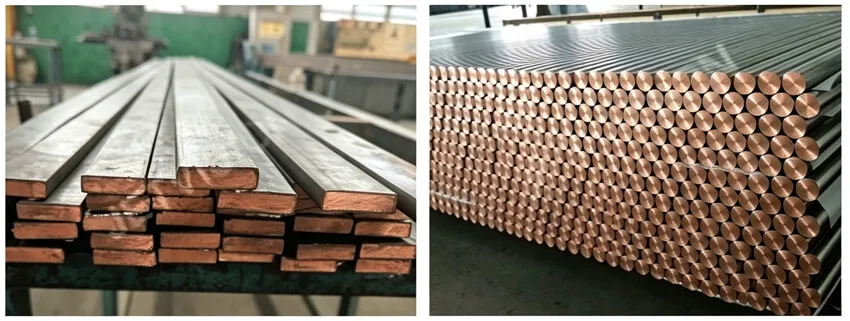
Titanium clad copper Flat Bar / Busbar
Titanium clad copper Round Bar
Titanium clad copper Drilled Bar
Titanium clad copper Bent Components
Titanium clad copper Welding Fabricated Parts
Titanium clad copper Machined Components
Custom holes, bending angles, welding structures and machining features can be produced according to customer drawings.
Dimensions, Tolerances & Engineering Specifications
A clear specification should identify:
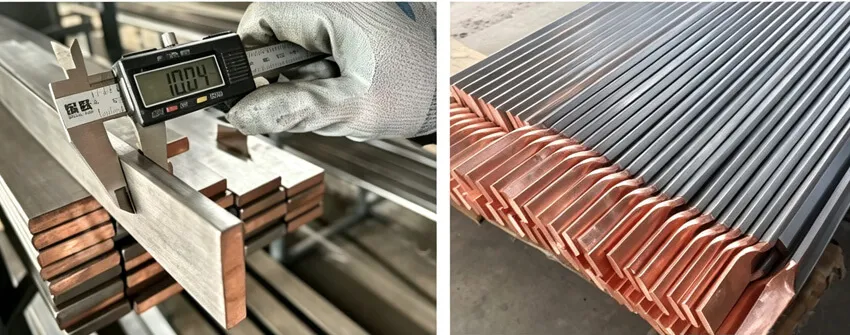
Overall width, thickness and length
Copper core dimensions
Titanium cladding thickness
Dimensional tolerances
Hole diameter and location
Bending radius and angle
Surface finish
It is particularly important to clarify whether the specified thickness refers to the finished Ti-Cu thickness or the copper core thickness.
For complex drilled, bent or welded components, a detailed engineering drawing is recommended.
Titanium Clad Copper Procurement Guide
A complete RFQ helps suppliers provide an accurate quotation.
Buyers should normally provide:
Material: Titanium grade + copper grade
Dimensions: Width× thickness ×length
Cladding: Titanium layer thickness
Quantity: Required pieces
Fabrication: Drilling / bending / welding / machining
Finish: Ground / machined / polished
Testing: UT, conductivity, mechanical or bond testing, if required
Drawing: For customized components
When comparing suppliers, consider not only price but also material quality, bonding technology, fabrication capability, testing, documentation and delivery time.
Quality Control, Testing & Applicable Standards
Quality control should cover both the raw materials and finished Ti-Cu product.
Typical inspection includes:
Chemical composition and PMI
Dimensional and surface inspection
Ultrasonic testing
Bond quality / strength testing
Electrical conductivity testing
Mechanical testing where required
Material certificates and traceability
Testing and documentation should be agreed with the supplier before production.
Titanium clad copper offers an effective combination of copper's electrical conductivity and titanium's corrosion resistance.
For successful procurement, engineers and buyers should clearly define the material grades, titanium cladding thickness, dimensions, fabrication requirements, bonding quality and testing requirements.
For standard Ti-Cu busbars or customized drilled, bent, welded and machined components, providing a drawing or detailed specification allows the manufacturer to evaluate the requirements and provide a more accurate solution and quotation.
 +86-731-82224155
 8613272400394
 enquiry@jetvisiontitanium.com